.png)


A business case tool can be an AE's secret superpower
You're evaluating business case tools for your organization. Dozens of options exist with overlapping claims and different strengths. Determining which capabilities actually matter versus nice-to-have features is challenging.
The stakes: wrong choice means low adoption, continued manual work, and missed approvals. This guide provides a decision framework based on your specific use case, deal profile, and team needs.
We'll cover evaluation criteria, platform differentiation, a comparison of leading tools, and implementation considerations.
Key Takeaways
- Match platform capabilities to your primary value challenge
- Key criteria: financial modeling depth, CFO-approval focus, ease of use, output quality
- Platform background matters: tools built by finance experts excel at CFO approval
- Start with clear success metrics before evaluating vendors
Step 1: Define Your Requirements
Identify Your Primary Use Case:
- Pre-sale CFO approval for enterprise deals
- Mid-market business case creation for champions
- Post-sale value realization and tracking
- Internal business cases for company initiatives
Map Your Current Pain Points:
Are deals stalling in CFO approval for weeks or months? Do champions lack tools to build financial justification? Is your team spending days manually creating business cases? Are you seeing inconsistent quality across different AEs?
Define Success Metrics:
What outcomes would justify platform investment? Reduce time-to-business-case from X days to Y hours? Increase win rate on deals requiring CFO approval? Shorten approval cycle time by X weeks? These metrics will guide your evaluation.
Step 2: Understand Platform Differentiation
Business case platforms differ along two key dimensions that help you narrow your options quickly.
Scope: Generalist vs. Specialist
Generalist platforms cover the full customer lifecycle from pre-sale through post-sale. Specialist platforms focus intensely on pre-sale CFO approval.
Feature Depth: Full-Featured vs. Basic
Full-featured platforms include advanced capabilities like Monte Carlo simulations, comprehensive financial modeling (NPV, IRR, sensitivity analysis), and scenario comparison. Basic platforms prioritize speed and simplicity over financial sophistication.
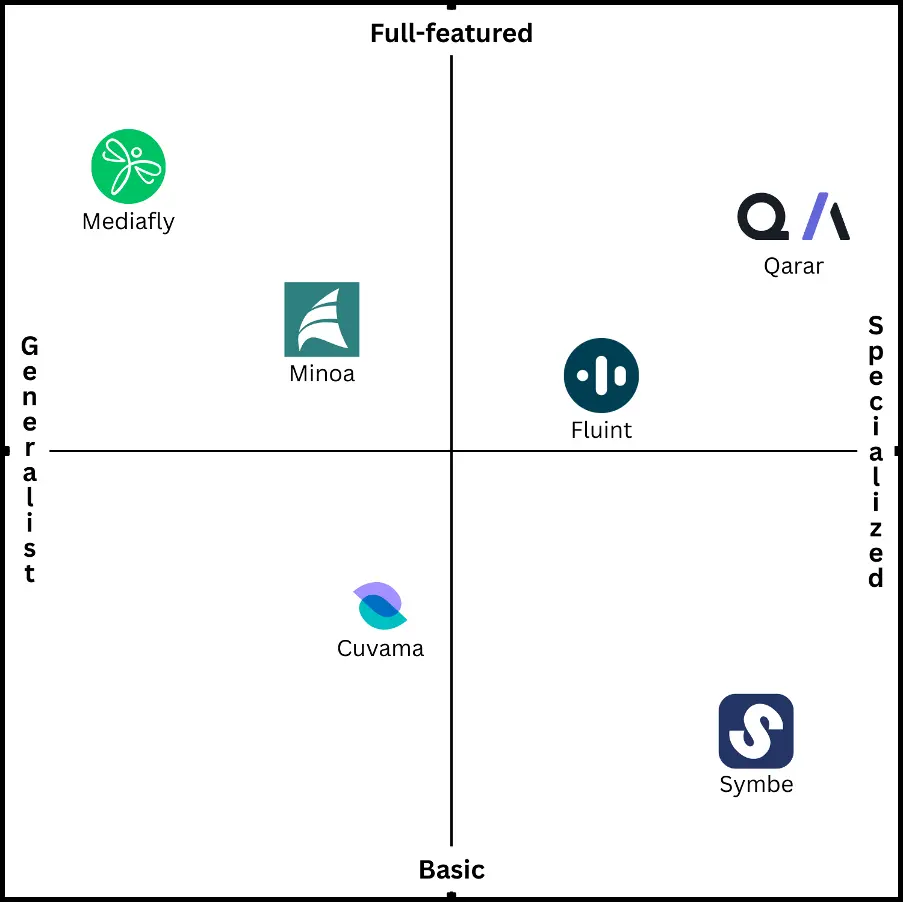
Full-Featured Generalists
One platform for the entire customer journey. Handle pre-sale business cases, value tracking, and QBRs.
Best when: Both sales and customer success need value tools.
Trade-off: Implementations take longer, less depth in CFO approval.
Full-Featured Specialists
Deep business case sophistication for CFO approval. Monte Carlo simulations provide outcome ranges with probabilities, not just single-point projections.
Best when: Deal sizes exceed $100K and finance scrutiny is high.
Trade-off: Focused on pre-sale, not full lifecycle.
Basic Generalists
Guided discovery and value management with lighter financial modeling. Help teams consistently execute value conversations.
Best when: Process consistency matters more than financial depth.
Trade-off: May lack rigor for large enterprise CFO approval.
Basic Specialists
AI automation creates standardized cases in seconds.
Best when: Pitching mid-market deals where speed outweighs financial complexity.
Trade-off: Less sophisticated than full-featured platforms.
For Enterprise AEs: If CFO approval blocks your deals, full-featured specialists are your best option. Showing a CFO "78% probability of exceeding $350k in value" (from Monte Carlo simulation) carries more weight than "projected 240% ROI" when finance teams scrutinize assumptions.
Business Case Platform Comparison 2025
- No subscription required
- Seat-based pricing plus platform fee
- Success-based pricing based on size and percentage of closed deals
- Seat-based pricing
Step 3: Assess Critical Capabilities
Financial Modeling Requirements:
Platform must calculate ROI and payback period properly, generate NPV and IRR with correct methodology, handle multi-year cash flow projections, account for timing of costs and benefits, and use appropriate discount rates.
Why it matters: CFOs spot incorrect methodology immediately.
Scenario Modeling:
Look for a range of outcomes with probabilities as opposed to static scenarios.
Why it matters: CFOs need to see change from current state with rigorous financial analysis, not just proposal in isolation.
Risk Analysis:
Must include sensitivity analysis features, test multiple variables simultaneously, generate multiple scenarios with probabilities, and show impact of assumption changes on all metrics.
Why it matters: addresses CFO risk concerns proactively.
Output Quality:
Professional documentation suitable for CFO or Board, executive summary generation, charts and tables for key metrics, and multiple export format.
Why it matters: credibility depends on presentation quality.
Step 4: Evaluate Vendor Expertise
Research platform background: Who founded the company? Sales professionals or finance experts? What problem were they personally solving? Do case studies match your buyer profile?
Implementation support matters: What onboarding and training is provided? How long until the team is productive? Are templates and best practices included?
Why vendor background matters: Qarar was built by CFO experts who evaluated business cases for years. The platform incorporates actual approval criteria versus theoretical best practices. This translates to higher approval rates.
Reference checks: Talk to 2-3 current customers with similar profiles. Ask about actual adoption rates, time savings, impact on win rates, and quality of support.
Decision Framework: Making Your Choice
Choose CFO-Approval Specialists When:
Average deal size exceeds $100K, CFO or Board approval is consistently required, approval bottleneck is your primary challenge, and you need maximum credibility with finance teams.
Choose Full Lifecycle Platforms When:
You need both pre-sale and post-sale capabilities, sales and customer success teams both need value tools, and you want a single platform for consistency.
Choose AI-Powered Tools When:
Speed is priority, you have quality call recordings, and deals are complex but under $25K.
.svg)
.svg)
.svg)
.svg)
.svg)
.svg)
.png)


.svg)
.svg)