.png)

What’s a CFO-Ready Business Case?
When it comes to evaluating investments or projects, there are business cases and then there are CFO-ready, or CFO-grade business cases. But what exactly makes a business case “CFO-ready”?
Overview
A business case is a clear explanation of why an investment or project makes sense. It compares the benefits, costs, and risks to help decision-makers like CFOs choose the best option.
In Qarar, a business case includes different scenarios which compare a proposal scenario to a baseline scenario, or even an alternative scenario to a baseline scenario. This helps compare choices and understand their impact over time.
The main parts of a business case are:
- Story (Qualitative Section): Explains the background, recommendations, risks, and next steps.
- Numbers (Quantitative Section): Includes cash flow projections, return on investment (ROI), payback time, internal rate of return (IRR), and net present value (NPV).
Key Terms
- Baseline Scenario: The current state or "do nothing" option.
- Proposal Scenario: The proposed change or project.
- Proposal Incremental Scenario: The difference between the Proposal and Baseline Scenarios.
- Alternative Scenario: A different option for comparison.
- Alternative Incremental Scenario: The difference between the Alternative and Baseline Scenarios.
- Actual Scenario: What actually happens, used to track results.
- Actual Incremental Scenario: The difference between the Actual and Baseline Scenarios.
Why Business Cases Matter
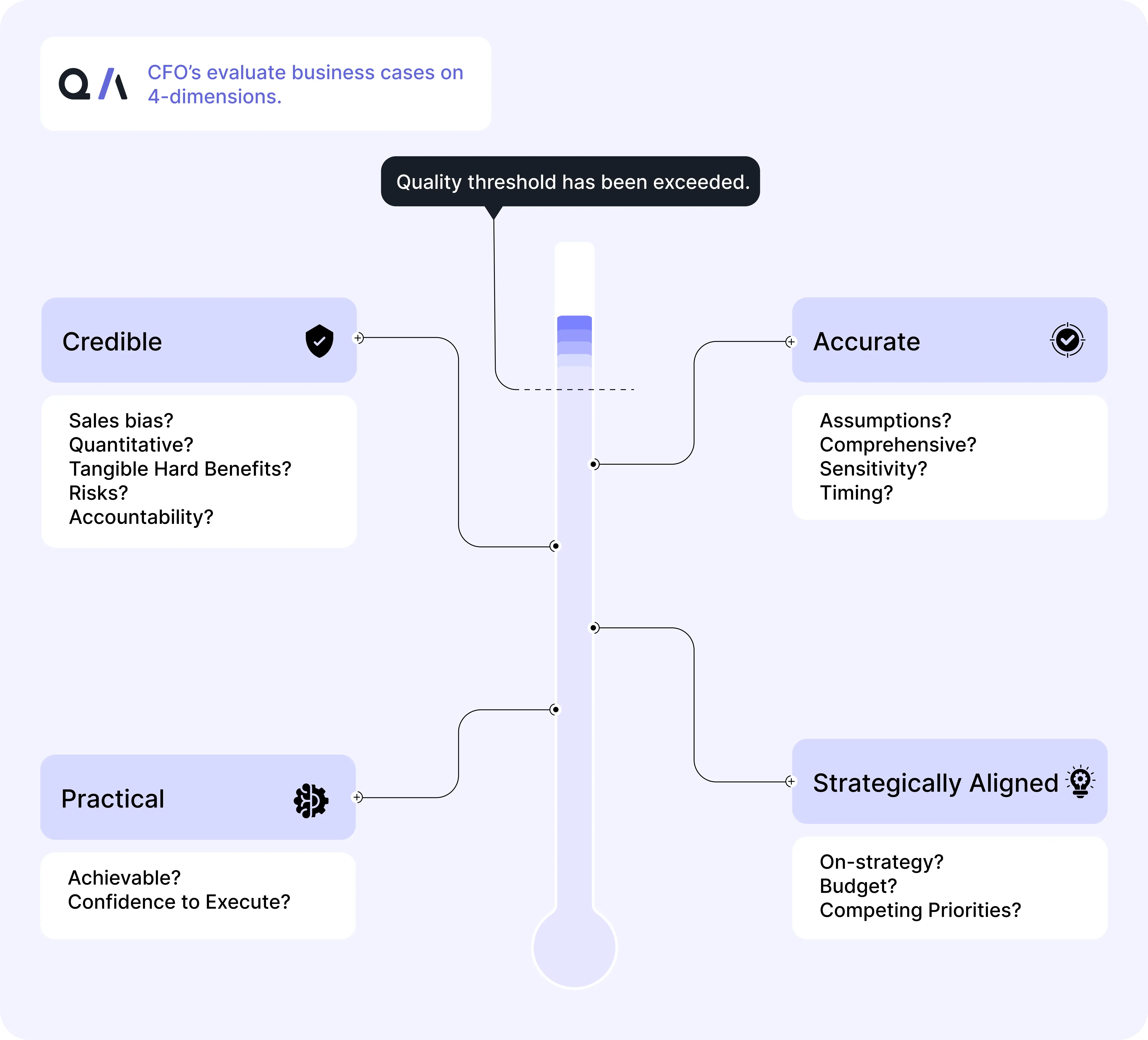
A business case helps organizations make smart choices, especially when spending money. It provides a structured way to weigh benefits against costs and risks. Finance teams and decision-makers look at four key factors:
1. Credibility
- Do I believe what is presented?
- Is it transparent and easy to follow?
- Is there "sales bias"?
- Is it quantitative? Are there tangible "hard" benefits (that can be proven, such as on a profit and Loss statement)?
- Are risks and mitigations presented?
- Who will be accountable?
2. Accuracy
- What assumptions are used?
- Is it comprehensive? Did they cover all situations?
- Did they think about uncertainty in outcomes (sensitivity analysis)?
- Is the timing of benefits and costs realistically presented?
3. Practicality
- Is it achievable and realistic?
- Do I have confidence that the team can execute and realize the benefits?
4. Strategic Alignment
- Is it "on-strategy," and linked to current objectives?
- Do we have a budget?
- Are there competing priorities that we need to consider the impact to?
Addressing all four of these factors is what makes a business case CFO-ready or CFO-grade
When to Use a Business Case
Business cases are relevant for almost any type of initiative or project, typically internal to a company, and may include situations like:
- New Purchases: Deciding whether to invest in a tool or system.
Note: As a salesperson selling to an organization, building a business case for your internal "champion" is a great way to enable your buyer and value sell, which can help increase sales win rates, reduce sales cycles, reduce discounting, and increase deal size.
- Cost Savings: Finding ways to cut expenses.
- Process Improvements: Comparing current vs. improved processes.
- Technology Upgrades: Justifying software or system changes.
- Regulatory Compliance: Weighing the cost and benefit of following new rules.
Note: Business Plans are different from Business Cases. Business Plans are typically used to think about planning the launch of a new business or company, not initiatives within a company. While some broad concepts are similar (like forecasting revenues or costs over time), they serve very different purposes.
How Business Cases Are Evaluated
Companies use business cases to decide where to spend money or invest, since there are always more projects/initiatives than resources, capacity, or budget to do them. This is known as capital allocation by Finance.
Finance doesn’t want decision-making to slow down the company from executing projects that drive growth. The formality of a business case depends on the size of the investment and the decision maker’s spend authority:
- Very Small Investment: Quick conversation
- Small Investment: Simple email approval
- Medium Investment: Short analysis
- Large Investment: Full business case
Other factors affecting formality include:
- Available cash for investments
- Risk tolerance of the organization
- Organizational maturity in investment decisions
- Company strategy and direction
- External factors like borrowing costs, economic health, and currency fluctuations
A CFO-grade business case helps speed up decisions, reduce confusion, and increase the chances of approval of a business case, irrespective of the size of the task. Over-delivering is never bad; it impresses the CFO or decision maker, especially if your peers are not.
How Qarar Helps with Business Cases
Qarar makes it easy and fast to build and evaluate CFO-ready business cases by ensuring all four dimensions that a CFO looks for are addressed: Credibility, Accuracy, Practicality, and Strategic Alignment. If you want more info Contact us now!
.svg)
.svg)
.svg)
.svg)
.svg)
.svg)
.png)


.svg)
.svg)